Events
Industry speakers, hands-on workshops, and club-wide sessions designed to sharpen your edge and connect you with the quant community.
Saved Path
Match the lineup to your plan
Use the events page as your next live rep, then jump back to the guide that fits your track before the session.
Event Recaps
Turn sessions into reusable notes
After major workshops and speaker sessions, recaps should capture the ideas, links, practice prompts, and follow-up actions worth carrying forward.
First actions
Club overview, application walkthrough, recommended starter resources, and the first project or practice rep to try.
Takeaways and notebooks
Core concepts, code links, problem sets, mistakes to avoid, and next reps by track.
What changed
Application windows, interview formats, firm-specific notes, and member lessons from the latest cycle.
Chat with Max Dama (Headlands Tech LLC)
Max Dama is Co-Chairman of Headlands Technologies LLC, a global quantitative proprietary trading firm headquartered in Chicago with offices in New York, Austin, London, Amsterdam, and Singapore. A UC Berkeley graduate in Mathematics, Statistics, Computer Science, and Business, Dama joined Headlands in 2011 and has become a respected voice in automated and high-frequency trading.
In this session, Max will discuss quantitative trading, industry preparation, and how students can build the right technical instincts for fast-paced trading roles.
Date and location to be announcedAlumni Spotlight: Traders at Transmarket Group
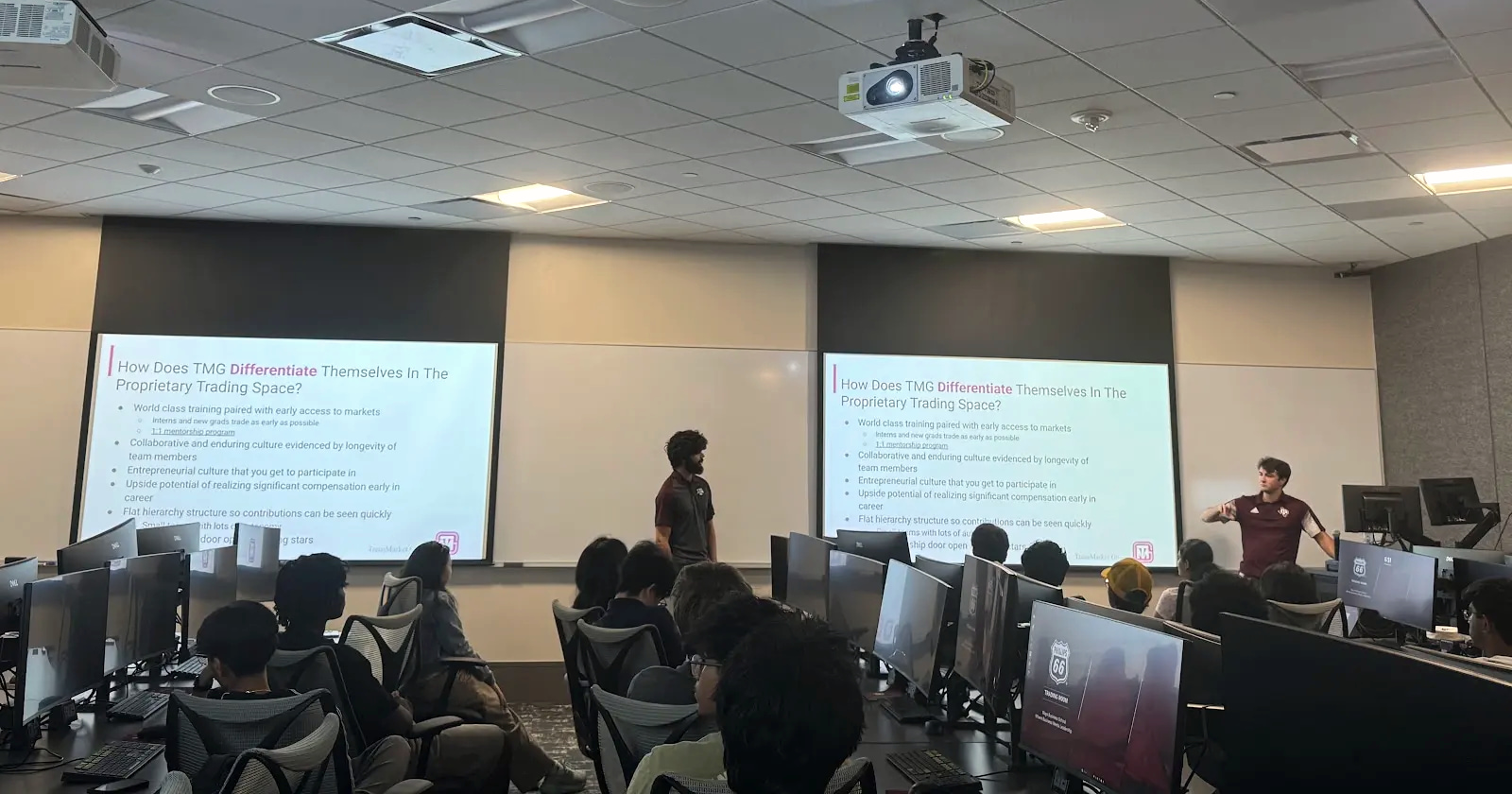
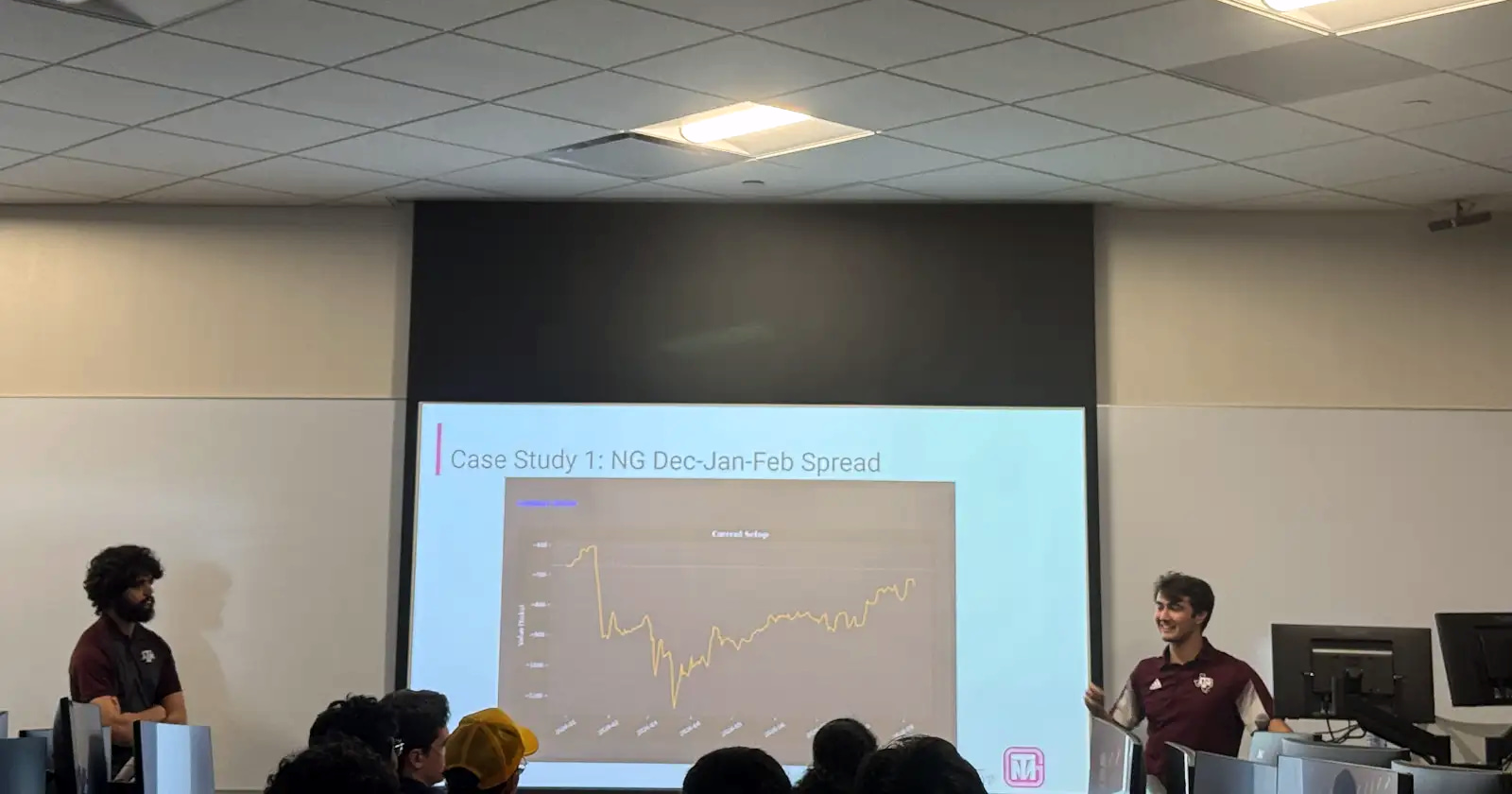
Two Texas A&M alumni now trading at Transmarket Group (TMG) — a Chicago-based proprietary trading firm active in futures, options, and fixed income markets — will visit to give a behind-the-scenes look at life as a trader at a major prop shop.
Jake Isakson (Class of '25) and Carter Kryzak (Class of '23) will cover what TMG looks for in candidates, how they broke in straight out of A&M, what the day-to-day of a prop trader actually looks like, and how to position yourself for similar roles. Expect a candid, recruiter-free conversation followed by open Q&A.
Date and location to be announcedInaugural Meeting
An opening session to introduce students to the vision of AggieQuant, walk through the application process, and explain why applying early is worth it.
Details pendingHow Quant Firms Work
Most students want quant jobs but have no mental model of the industry. This session breaks down how prop trading firms, hedge funds, and bank quant desks differ — covering org structure, how researchers, traders, and developers interact day-to-day, and what compensation structures typically look like. Builds the conviction and context needed to target applications effectively.
Date and location to be announcedDiscovery Day Prep Session
A live walkthrough of the AggieQuant Discovery Day guide — covering what Discovery Days are, which firms run them, how to apply and what they look for, what happens on the day itself, and how to follow up effectively. Includes open Q&A. Timed to run several months before typical application windows open in the fall.
Date and location to be announcedPython for Quant Finance
A 2-hour hands-on lab using provided Jupyter notebooks. Members will ingest and clean OHLCV price data with pandas, compute rolling statistics, build a simple moving average crossover strategy, and plot results end-to-end. Accessible to anyone with basic Python knowledge — no prior finance background required.
Date and location to be announcedProbability & Brainteasers Session
A recurring 1-hour problem session modeled after real quant interviews. Each session covers 3–5 problems drawn from Heard on the Street and the Green Book. Members work individually for 5 minutes, then the group works through each problem together. The emphasis is on verbalizing the reasoning process — not just arriving at the right answer — since that is what interviewers are actually evaluating.
Recurring — date and location to be announcedMental Math Drills
A focused 30-minute session on the arithmetic fluency that quant trading interviews test under pressure. Covers rapid arithmetic, fraction and percentage conversions, Fermi estimates, and approximation techniques. Uses timed drill tools alongside custom sheets for finance-specific numbers like option multipliers and DV01s. Can run as a standalone session or as a warmup before other events.
Date and location to be announcedOrder Book & Market Microstructure
A 1-hour lecture paired with a live simulation exercise. Members learn how limit order books are structured, how trades execute, and how bid-ask spreads decompose into adverse selection and inventory costs. The session ends with a manual market-making simulation where members act as market-makers under different information conditions. Core knowledge for quant traders that almost no coursework covers.
Date and location to be announcedOptions Pricing from Scratch
A 1.5-hour lecture with live coding. Starts from first principles — building intuition for what an option is, introducing risk-neutral pricing, deriving the Black-Scholes formula, implementing it in Python, and computing and visualizing the Greeks and P&L surfaces. Requires basic calculus. Serves as a strong bridge between the math and trader tracks, and directly prepares members for derivatives questions in quant interviews.
Date and location to be announcedML for Finance — Doing It Right
A 2-hour workshop on why standard ML techniques fail in finance and how to apply them correctly. Covers non-stationarity, look-ahead bias, proper train/test splits for time series, feature engineering on price data, implementing a simple momentum signal, and evaluating it with walk-forward validation. The emphasis is on what not to do — most members have done ML, but not finance ML. Directly relevant to the quantitative researcher track.
Date and location to be announcedLow-Latency Systems Primer
A 1.5-hour deep dive aimed at students on the quantitative developer track. Covers why latency matters in high-frequency trading, cache hierarchy intuition, branch prediction, and how to benchmark code effectively. Includes a live C++ demo comparing a naïve hot loop against an optimized version to make the performance difference tangible. Niche but very high-signal for students serious about systems-level quant roles.
Date and location to be announcedMock Technical Interviews
A 45–60 minute paired interview session with rotating feedback. Members interview each other using real-style questions appropriate to their track — mental math and probability for traders, statistics and ML for researchers, data structures and systems for developers — then swap roles. The session closes with a group debrief on common mistakes. Questions are sourced from actual recruiting cycles.
Date and location to be announcedResume Workshop
A 1-hour session focused on what quant recruiters actually look for and what most student resumes get wrong. Uses anonymized before/after examples to illustrate common mistakes. Members then peer-review each other's resumes in small groups with a structured rubric. Everyone leaves with specific, actionable items to fix — not vague feedback.
Date and location to be announcedCold Outreach & Networking Strategy
A 45-minute workshop on how to find and reach quant professionals effectively. Covers how to identify relevant contacts on LinkedIn, what separates a compelling cold message from one that gets ignored, and live examples of both. Members draft an outreach message during the session and get peer feedback before sending. Everyone leaves with a ready-to-send message in hand.
Date and location to be announcedBook Club
A monthly 1-hour discussion rotating through the books on AggieQuant's resource guides. The reading list starts accessible — Thinking in Bets for game theory intuition — then progresses to Trading and Exchanges for microstructure depth and Advances in Financial ML for the researcher track. One member prepares a 5-minute summary each session, followed by open discussion on implications and real-world applications.
Monthly — date and location to be announcedGame Theory & Puzzle Nights
A casual 1.5-hour social event built around combinatorial games, probability puzzles, deduction games, and calibration exercises. Low-pressure by design — meant to be fun while quietly sharpening the reasoning instincts that quant interviews test. Good entry point for students who are curious about quant finance but not yet ready for hardcore technical content, and an easy event to bring a friend to.
Recurring — date and location to be announcedRecruiting Debrief
An end-of-season retrospective held after each major recruiting cycle. Members share which firms recruited on campus, what interview formats looked like, what prep worked and what didn't, and any surprises from the process. Findings are documented and passed to the next cohort. The goal is institutional knowledge that compounds year over year — so each class starts better-prepared than the last.
End of recruiting season — details to be announced